
Episode 621 - NICHOLAS MEYER Talks Star Trek and Beyond
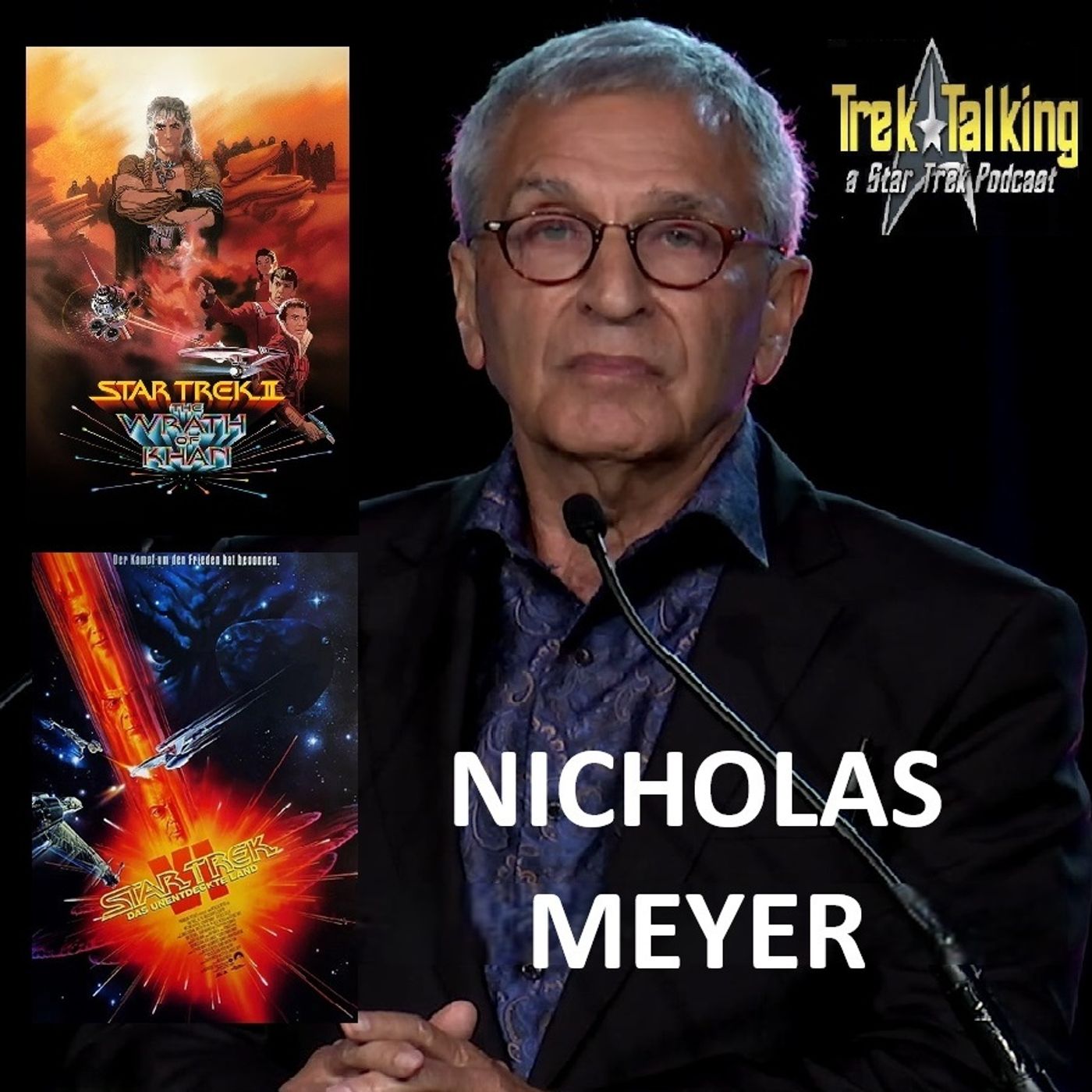
In this engaging conversation, Nicholas Meyer, the director of Star Trek II: The Wrath of Khan, shares insights into the film's development, including its original title, the musical score, and the artistic choices made during production. He discusses...

 Apple Podcasts

 Spotify

 Castro

 RSS Feed
In this engaging conversation, Nicholas Meyer, the director of Star Trek II: The Wrath of Khan, shares insights into the film's development, including its original title, the musical score, and the artistic choices made during production. He discusses the challenges of working with iconic actors like Ricardo Montalban and Christopher Plummer, and reflects on the themes of the film, including its nautical influences and the importance of artistic interpretation. He also touches on his other works, including Time After Time and his views on Sherlock Holmes adaptations. In this engaging conversation he reflects on his journey from aspiring actor to acclaimed director and writer, sharing insights on the importance of storytelling, the nuances of directing, and the collaborative nature of filmmaking. He discusses his experiences in the film industry, particularly with Star Trek, and emphasizes the significance of language and character development in creating impactful narratives. In this engaging conversation, shares insights from his illustrious career in filmmaking, discussing the importance of collaboration on set, the creative intersections of Sherlock Holmes and Star Trek, and the inspiration behind his novel 'The 7% Solution'. He reflects on the profound impact of his television film 'The Day After', which sparked national conversations about nuclear war, and concludes with thoughts on legacy and the meaning of storytelling in his life.
0:06 All right, good evening, Trekies and trek Is around the globe. Welcome to Trek Talk and episode six hundred and twenty one. We're here with Nicholas Myers. Welcome to the show. Nicholas, thank you. It's my pleasure. Okay, we finally got this going down right. Uh. Sorry for the delay, guys. We had a lot of technical difficulties for some unknown reason, but I think we got them worked out and I appreciate your patience. So I didn't get a chance to finish your entire book unfortunately, so I only have a couple of questions that I wanted to ask from as far as I got into the book. And one of the things. I wanted to talk about was what was the original title for Star Trek two. The Wrath of Con wasn't the Wrath of Con.
0:50 It was the Undiscovered Country. Yeah, so how come, how come you where did you come from? Wrath of Con? And why did you have to change it? I was informed in the middle of shooting by my assistant. She came onto the set and said, I think they're changing the name of the movie, and I said, no, they're not. I'm very busy, and she came back a day or so later, and she said, yes, it's now going to be called the Vengeance of Cohn. And I said, where the fuck did that come from? And she said, well, there's some gentleman in New York named Mancuso. And I said, get him on the phone. So I said, mister Mancuso, this is mister Meyer. I am the writer director of Star Trek two. How do you do mister Meyer? I said, well, I'm a little troubled. Do I understand that you intend changing the name of the film and he said yes, I do. I said have you read the script? He said no, I have not. I said have you seen any of the dailies? He said no I have not.
2:10 I said, don't you think it just displays a certain lack of savoir faire. Let us say that you haven't read the script, you haven't seen the dailies, and you haven't had the courtesy to contact me, as the creator of the film, to tell me what you intend. The little pause. He said, mister Meyer, I'm only trying to do what's best for your movie. I said, uh huh. Are you aware that Paramount Pictures does a lot of business via the Indiana Jones franchise with George Lucas. Yes, of course I know that. I said, are you aware that George Lucas's new movie is called The Revenge of the Jedi. Do you think he's going to take very kindly to your calling this film the Vengeance of con He said, I assure you, mister Meyer, that will not be a problem. Ah. And so three days later or whatever it was, I've got Barry Dillery yelling at me, who the fuck knows what wrath is? Who knows what wrath?
3:20 Where do they get the fuck wrath from? Take that off? Please? And take that off? Please, um get rid of that, please, thank you. And so we wound up being called the Wrath of Khn. And that's the way it was until we got to Star Trek six, when mister Mancuso wasn't there and I was briefly the eight hundred pound Gorilla, and I said, the name of this movie is going to be Star Trek six, The Undiscovered Country. And they said, oh, that title seems a little soft, and I said, you think it's soft, but you've already had the last, the Final, the ultimate. To that, I said, nobody's paying attention to these superlatives. Anymore. Why don't you throw them a curveball once in a while. I'll make a deal with you. You come up with a better title and we'll go with it.
4:25 So then this is on Star Trek six. We had a meeting there about thirty people in this room, and they all had computer sheets, you know, the ones that have the little punch holes in them, and they're pulling out Yeah, and so the computer is generating names. This is early AI, and so it would take a word like tomorrow or escape or bridge, and it would make up titles saying bridge to tomorrow, escape from yesterday. And they were like sheets of these, and I would I said, okay, well, let's let's start with a bridge to tomorrow. Anybody anybody like bridge? No, okay, what about a bridge from yesterday?
5:13 Any anybody? Guy says, all right, you win. And that's how it became The Undiscovered. That's an excellent story, you know. I was also interested in the music for Star Trek to the Wrath of con I think that the soundtrack is is really one of the high points of the movie. How did you settle on, James Horner? Well, remember Star Trek two was being made for Peanuts and you know the first movie Star Trek. The motion picture was I think forty five million dollars in nineteen seventy nine. That was insane. So we were given I think eleven point two to do this movie, and so we definitely could not afford Jerry Goldsmith or anybody of that ILK, assuming there was anybody of that ILK. So we were auditioning and people would send in cassette tapes and I would listen, and I think Joe Silver, Joe Silver, I think that was his name. I may be getting it wrong, which embarrasses me because I shouldn't. But he was head of music at Paramount, and one of the tapes he sent me was James Horner and said listen to this, and I thought this was very interesting. And then I met James and we got along quite well, and I said, this is a movie about the Navy,
6:48 and I want it to look like the Navy. I want it to sound like the Navy, and if I had my way, we would use w C LA maire was I'm on ocean, and he said, okay, I hear you. And then he came back to my house a couple of days later and we sat down at my piano and he started playing, and I said, okay, you're it. Some great stuff for sure. I also I learned something. Would you talk a little bit about the SETI eels that Ricardo Maltalbon has crawling around in the dirt there, and about his glove.
7:33 You know, it's my opinion that the artist, in this case me should not be approached as if he were the answer. At a book of math equations at the back, somebody said to Margot Fontaine. They said, oh, Dame Margo, I so enjoyed you're dancing. Tell me what were you doing up there? And she had the presence of mind to say, I'm very sorry, but I explained what I was doing while I was doing it. If you didn't understand, then I failed. And so I think perhaps understandably reluctant to offer a sort of explanations and take people behind the scene. When people say to me why does Cohn wear only one glove? I always turn the question around and say, why do you think he wears only one glove?
8:39 So I have to sort of decline those kind of explanations. They're always a little reductive, don't you find Like when a magician explains the magic trick once you learn how Houdini walked through a brick wall. And when Holmes explains to Watson how he did X Y, and Watson is always disappointed. He says, Oh, for a moment, I thought you had done something really clever, and I want you to keep thinking that I've done something really clever. And I worry that if I explain how I did it or why I did it, it loses some of its magic. It's mystery, so I have to tread carefully in answering your questions. I guess you have to make up your own mind about why he wears one glove. I think that art that asks questions is much more interesting than art that answers that. And I think artists lose all proprietary authority or control over their work when it's finished.
10:00 We're like people who put messages in bottles, and you throw the bottle out there and hope that somebody's going to find it, pop the quirk and go oh wow, this is interesting or not. But for sure you're not going to be there when they're doing that, looking over their shoulder and helping to decipher some water logged handwriting and say no, that's not gum, that's gun, and so forth. People will have to make of movies and works of art and books and pieces of music what it means to them and how they view it. It's the difference in a way between also a reviewer and a critic.
10:44 A reviewer tells you whether you should spend your time and your money to go see the movie, and a critic, as Anatole Franz said, narrates the adventures of his soul among masterpieces. Take out the word masterpiece, if you get the idea. So it's more me wanting to hear what you guys have to say, and I'll take you know. I'll answer some questions, but I can't answer the white glove. And as you may have noticed, I'm very long winded. I thought he was a fan of Michael Jackson, but that was just, that was just. I have to tell you that I barely know who Michael Jackson is.
11:28 Okay, fair enough, I uh. Now, you had the pleasure of working with the late Ricardo Mantlebon and also Christopher Plumber. I wanted to ask you what is the difference between both of their two styles, their acting styles, and and how he directed them differently. Well, that's a very interesting that. That's a very interesting question. I'll sort of take them in order. Montlbond and and Plumber has had a lot in common. They were both extremely gifted performers, gifted actors, and very very both of them very very professional. The major difference, I think is that Ricardo, as he said to me very early on in he was the only actor I didn't get to rehearse with. I rehearsed with everybody, but he was busy doing his television series so he could never come to rehearsals.
12:35 I met him for lunch. I gave him a copy of Moby Dick. I said, read this, this is it. And then I didn't see him till opening shooting day, when he showed up in full drag, ready to go, and we were doing the scene in the Botany Bay Cargo Bays where Con explains who he is and why he's so pissed off. I think it was a six page scene. And with my theater background, and I only directed one other movie, I thought, movies they're always telling actors to start and stop and pick it up and cut, and there's quite as interruptist. I said, why not let the guy work up a full head of steam and I'll dance the camera around him while he's doing his soliloquy, his grievance speech. So there were like twenty one marks for him to hit, and he came. He had memorized everything, total pro and he hit every single mark first time out.
13:42 But he screamed the whole thing at the top of his lungs. It was just we were all standing there from the sound guy clutching his headphones, and nobody sort of knew what to do, including Missus Meyer's oldest who just thought, Wow, this guy has more credits than anybody in the world. What happens if I try to tell him something? Does he punched me out because that's his real chest. And so I said, so let's let's now they're going to do the lighting that they know the scene, and let's let's talk a little bit about interpretation in your in your dressing room. And he's very he's very courteous.
14:34 He was very almost courtly, And I think actors always want to know the same thing about the director. Is he crazy? Am I going to live? Do I have to pull the boat over the mountain. So we didn't know each other. We just had that one lunch and he was courtly and it's hard to get past that. So we're sitting down in his dressing room and I said, you know, taking my life in my hands. Laurence Olivier once said that an actor should never show an audience as top, because once you show an audience your top, they know you've got no place else to go. And he leaned back and he looked at me and he said, oh, so you're gonna direct me. He said, that's good. I need direction. He says, I don't know what I'm doing up there. And he then proceeded to tell me all these stories about directors who would say things like Ricardo, Lana, make it a good scene, or give it balls Ricardo.
15:53 You know, it's these things are not typically helpful. So the other thing I said to him, I said, okay, you know, I said, always let them. I think you've got something in reserve. You've got secrets and crazy people. They don't have to shout because you just never know what they're going to do next. And everybody he jumped and he said okay. And so this was the beginning of our collaboration, which was intense, and it was the only time I've ever known what it felt like to drive a Maserati because you didn't have to press the pedal very hard. And he was very smart, so he could finish your sentences and he would check on every little thing. Nick, what if I raise the eyebrow here?
16:58 And I'd say, yeah, not not too high. And so that was our collaboration, and he was really eager for all of that. Plumber was way more sophisticated in many ways as a theater actor because he had done a lot. Ricardo had been on stage. He'd done Man and Superman or Don Juan in Hell on Broadway. He'd done Jamaica with Lena Horran, Lena Horne the musical. But but Christopher was really a stage actor and he movies were hard put to contain him, so he really always had to muzzle down, down, down.
17:49 He was also. Extremely smart and very knowledgeable, and if you didn't know your stuff, he could sniff it out real fast. But we did have some time together to get to know one another, and he was very musical. We had music in common. We were both orchestra holics, so we kind of bonded over the music stuff and also of my love of Shakespeare. Unlike Kahan. I wrote the part of Chang specifically for Christopher Plummer because there was a Chandos CD which I own, of Plumber doing speeches from Henry the Fifth to the score written by William Walton for the Olivier movie. And I would just love to lie in the dark and listen to once more onto the Breach or close up the wall with our English while this music was played. So when I wrote Chang, I wrote it so that he was a Shakespeare spouting Klingon, so I could just turn him on every day we were in the studio and say do that thing about cry Havoc and let's slip the dogs of war. And
19:21 so he, I think, was amused by this whole idea, and particularly my favorite line in the movie, you have never experienced Shakespeare until you've heard him in the original Klingon. This was a steal. Everything I do is a steal, because all art is a history of cut and paste, and in this case, it was the Nazis who used to say you've never heard Shakespeare until you've heard him its original German. So I just changed it to cling on.
20:04 I love that, I love that one more question and then I'll I'll let Paul jump in here. I wanted to know how involved were you in the. Director's cut A Star Trek to the Wrath of kN. What do you mean how involved? Well, there's a there's a couple of scenes that were added that weren't in the original theatrical cut. But it's all the director's cut for a reason, isn't it. Yeah, that's what I wanted. That's was my question. Why were those Why were those things not in the original movie? Versus question that's a different question. I lost some battles before the feature version of the film was released, and you know stupid, I mean the studio. It's like a dog peeing to markets territory. Somebody has to. You know, I'm sort of stepping on my own joke. But you know that the the director and the producer or in the commissary and they're having soup and the writer says, this soup is perfect, and the director says, you know what, you're right, it is perfect. Maybe you could use a little salt, but otherwise perfect. And the producer says, boys, you're both right, but I know how to make it even better. And that's why I'm going to piss in it.
21:26 So that's what the studio felt its need to do. So they didn't want Midshipman Peter Preston to be identified as Scotti's nephew, and a couple of other really stupid, ridiculous things that I lost in the feature version of the movie. But once it was time to do the VHS tape or whatever we were doing back then, then they didn't give a shit, and so I got to put back in the things that I lost. Excellent. All right, Well, thank you so much. I'm going to unmute Paul and I'm gonna let Paul in here.
22:09 Thank you, Uncle Jim, Thank you, mister Meyer. Wow. I cannot believe I am actually having the great pleasure of getting a chance to ask you some questions here at tonight. I've already learned two really important things tonight. One is that you have the patience of a saint when it comes to technology, apparently, and you're funny as hell. So we're learning so much tonight. Funny is held from Star Trek four you guys like Italian. Who does it? It's great. What a crowd pleasing gift you have, my friend, I'm telling you, I want to ask a Wrath of con question, just to build on some of Jim's stuff here a little bit. And you'd mentioned Moby Dick and that this was a movie about the navy, right, and I mean coming on the heat of the motion picture, right, which is kind of stately and slower and a little you know, ponderous, right, Wrath of Khan is just so it's such an energetic departure after that, right, it's so nautical. It's uh, it's Horatio Hornblower.
23:15 Nautical and nautical but nice as my late. Yeah, and I'm just I'm just that whole seafaring motif. It just rocks so hard. And can you tell us just a little bit how that how you got that involved in there, and how you were able to bring that vitality and that that nautical vibe to it. Well, the fact that it works is a is its own miracle. I say, movies are like souflets. They either rise or they don't, and you never know by what alchemical miracle these things happened. I had never seen Star Trek. And by the way, for this and other you know answers, I refer your listeners, uh to my Star Trek memoir, which is called The View from the Bridge, Memories of Star Trek and a Life in Hollywood. It's available, as they say, and may tell you a lot more than we're going to get to in this conversation. I had never seen Star Trek when.
24:14 It was on. Originally it didn't make any sense to me. I just zipped by it. The guy with pointy years and everybody running around in doctor Denton's or whatever they were. I think it's fair to say that I missed everything worthwhile and important and meaningful about that series. I missed the fact that it was an international interracial cast. I missed the fact that women were in positions of power. I missed what it was trying to do, that there was a rush. I just missed everything because because it looked cheesy to me, and so I didn't stay with it.
24:55 So when I met Harve Bennett, who was the producer of the movie, who'd been hired to make a second Star Trek movie for Peanuts compared to the first Star Trek movie. And Harve had done a lot of television. He had done the Mod Squad, he'd done Six Million Dollar Man, and I think he did the first mini series. I mean, I know he did it. I don't know if it was the first rich Man, poor Man and Harve had. He was really, really smart. He had been a quiz kid, if you remember the old radio program, and so neither of us knew anything about Star Trek.
25:42 But he. Watched all seventy nine episodes or however many episodes. He watched every one of them, and he showed me a few of them, and he showed me the movie. And I don't knock the movie because somebody had to go boldly where nobody had gone before. And by the way, it should be go boldly. You don't put the modifier before the because I am a pedant anyway, So I kept thinking, well, there's something that I like about this, but I knowing me, it took me forever to figure it out because I think slow, I read slow. If I talk fast, you can be sure I'm playing a tape. Anyway, I thought about it for a while and I thought, oh, yeah, this is like those books that I read when I was thirteen years old about Captain Horatio Hornblower. Is this is the Navy in outer space. I know how to do that. And so that was my way in, and it was enough to enable me to make the movie.
26:59 It was not enough ultimately for me to ultimately understand and come to terms with what Star Trek is. I was still a little dense in that department, So it took me another thirty years sort of figure out why what this was trying to do. But you know, there are some things that you can you can do without knowing how you do them or what makes it right. So Hornblower was enough to sort of get me through it. And then I just when I was writing it, I just had to make the people real. So I just had to think, you're on deck, you're in the hole, you're in the galley, you're behind the guns. Who are these people? And the fact that as I was writing it, I realized certain themes began to emerge. And the themes were old age because they were all getting old friendship, implacable hatred and death. Old age friendship, implacable hatred and death, death.
28:27 And then I was kind of writing into those notions and building on those. It's like a brass rubbing. You know, there's things starts to get clear as you're working. Well. I have had the pleasure a couple of times in the last like five years of seeing Wrath of Khan in the theater again, and I just have to say that it's a picture that the audiences still just go nuts for it. I mean, admittedly, probably we'll see it. It's it's pactful of fans because people are so excited that, oh, it's back in the theater again. I gotta go, I gotta see it. And so there's a you know, a very dedicated, loyal audience. But regardless, they just love it and eat it up. And it is such a treat just to watch the audience. You know, they're rising up out of their seats through most of Act three. It's just incredible. I mean, they're really entertained. That picture delivers like nuts. And it blows my mind to hear that you made it for eleven million dollars back then. That's just that's crazy. That is crazy.
29:29 Well, I have a theory, and my theory is that art thrives on restrictions. Not only is all art a history of cut and paste. Let's face it, the Odyssey is a fanboy sequel to The Ill, right, do I lie? I think you might have a good point the fanboy sequel to the Odyssey, and didn't Mozart reorchestrate Messiah handle, you add, you cut, you paste, you make it different, and you build on what goes before. The words of the Catholic Mass are pretty standard. There's the Annua's Day, there's the resurrect there's the Hosanna it but people write different music to it. And you would never confuse the heightened Mass in time of war with the Verity Requiem or the Mozart Carnation Mass. But saw the same words.
30:30 Or to put it another way, the shape of the bottle is the same. But those of us who toil in star trek get to pour our own vintage into that. The bottle's got to have Kirk, it's got to have McCoy, it's got to have the other one, you know, and so on and you But the but the shape is sort of Gene Roddenberry's shape, what he came up with, and within that you cut and paste and fool around. M hm so. And the the other thing, I will say, Apropos. We've we've talked about it as a soufla. There's a soufle that that rose rose big who knew, not me, not anybody else, by the way, until it was sort of in the finishing stages, and then people started, We're getting all excited, and you know, do we really want Spock to die? Even Leonard was having second thoughts about well, when you I sort of strayed from my my point, whatever that point was.
31:36 Going to be. You just, oh, I know it's I was thinking that somebody recommended a general to Napoleon and said this guy is a very good general, and Napoleon said, I know he's good, but is he lucky? Perfect? Perfect? Perfect? I want to go back just a little bit because this is a picture that I just frankly adore, and the first time I saw it, I felt like I was coming out of the theater just with with wings on my eels. Is is? I just love time after time.
32:19 I just think it is a remarkable entertainment and h thank you. It is just delightful. There's something about the idea of taking a real person from history and turning them into a fictional character was just enchanting to me. And you have this man who's propelled by reason and science and hope, and you contrast him with this dark agent of chaos John Leslie Stevenson. It's just magic. And somehow there's a there's a love story in the middle of all that. It was just I was just enchanted for the entire time. I just thought it was one of the best written movies I've ever scene. I I try to get back and watch it at least once a year. I just think it's absolutely wonderful. And I'm always amazed when people say, oh, I've never seen time after time and I just want to throttle them, like, what are you talking about?
33:12 Use it somewhere in time? Christopher confirm for me, Is it true that that I've heard this this story that at one point Mick Jagger was considered to be John Leslie Stevenson. Is that is that really the case? Warner Brothers wanted me to use him. So it was a studio again, kind of adding to the suit. Well, they were trying to, you know, make it commercial, you know, uh, they were trying to We didn't have a star Malcolm Malcolm was popular, but he's not really or he wasn't really a star. And David Warner, who's a terrific actor. He was the great First War Hamlet, he was the Carnival Street Hamlet. But he's not a star.
34:02 And I originally wanted Derek Jacoby from I Claudius to be Wells and they went who so they were they were really you know, front loaded with with somebody, And maybe the movie would have been a bigger hit than it was if Mick Jagger had played the Ripper. I just didn't think I could believe him as the Ripper. I think we'd only see Mick Jagger and it would sort of disbalance the movie. Wow, I'm so glad you you went with the cast you have, because to me, it's just a magical cast. I mean, I'm a big David Warner fan like forever and but but that movie, I mean that's just like me.
34:43 Is this a David Warner that's like him at his best? He's just when he sits down and mikes mikes uh HG watched the TV. It's just like, look at where we are, Herbert, It's just. Look at where we are? Yeah, terrifying. So it's I think that's why a lot of us keep going back to Star Trek though. It is just because it like says, you know, things can be dark and crazy, but there's hope and we might somehow finally grow up. So I think I need extra doses of that message from time to time. I think, just just I'd be happy to od on it.
35:25 But I just wow, I mean, that's just I just have to tell you one of the greatest movies I've ever seen. I'm such a It's just an enchanting piece of work. I just absolutely love it. I want to ask you a question because I know that some of the other Truk experts are really going to probably go to town with you on you know, we have, like to me, I think one of the great Sherlock Holmes experts of our all time with us here tonight. It's like, so there's gonna be some Sherlock Holmes questioning. But I would like to ask you, sir, my friend, who is your favorite actor's depiction of Sherlock Holmes. Are you more of a Basil Rathbone guy or a Jeremy Brett guy who rocks your world? On two twenty on Baker Street.
36:11 I rather liked Peter Cushing in The Hound of the Baskerville IM movies. I have a lot of problems with Basil Wrathbone, one of which is that he looks like he's Sherlock Holmes. He sounds like he's Sherlock Holmes, but I can never quite sense the wheels going round. I don't. There are actors, you know. You look at Gary Cooper and every feeling, every emotion is there. You can just you can see him, you know. And and when when you saw Mel Gibson his Hamlet, it's all there, you can see the wheels. And then there's people that they sort of do everything right, but you can't see inside.
37:02 And that's one of my problems with Basil Rathbone. The other is that he's shackled with Nigel Bruce. You know. When we talk about Sherlock Holmes, which I'm happy to talk about, and everybody should read my new Sherlock Holmes novel, Sherlock Holmes and the Telegram from Hell, which is really good. And if my mother were here, she'd say. So, that's a great title. By the way, that's a pretty badass title. That's great. It was a real telegram. It's a real telegram. I've got it around here someplace, but you have to decode it, which they finally did. And it's a rather hair raising story, Sherlock Holmes and the Telegram from Hell. But I'm a purist.
37:56 I read the home stories when I was about eleven or sixty of them. My dad gave me the complete book, and that's the homes I like. I don't really like Holmes in the movies, apecially didn't like Rathbone and Nigel Bruce because I could never understand why a genius hangs out with a jerk. It didn't make any sense to me. And if you read, if you read the Holmes stories that you can't imagine that Nigel Bruce is the Watson who's writing them down.
38:37 It doesn't track at all. And when I wrote my first Holmes book, The Seven Percent Solution, I was trying to write a corrective to all the Sherlock Holmes movies can't stand and I don't like many of them. I thought The Hound of the Baskerville's with Peter Kokishing was pretty straightforward, no nonsense Holmes. It's got you know, maybe the Hound could be better, but whatever, but it was. It wasn't playing games with it. It was just this is how This is as close to what Doyle was writing.
39:20 And I think Andre Morrell is Watson in it, and he's a very good Watson, very you could imagine him. And we were talking a little bit before about mixing fictional and non fictional characters. When I wrote The seven Percent Solution, which is Sherlock Holmes meets Sigmund Freud, I was combining. I wasn't the first person to combine fiction and nonfiction around the same time that The Seven Percent Solution came out. That's when E. L. Doctor Roh wrote Rag Time, Houdini and a lot of other well known but even Walter Scott and to some degree, Shakespeare. It's not a new thing combining fictional and nonfictional people. We call out the historical novel.
40:24 Well, the way you do it's pretty amazing, would be what I have to say, and have a unique take on it. The other te experts are going to kill me, but I got to ask you one last question, just quick, quick two parter right, favorite movie of yours as a kid growing up and then over to say the last ten years, what has been the movie that you're like, that's a freaking movie. That's a good one. My favorite movie when I was a kid was probably the Walt Disney twenty Thousand Leagues Under the Sea, which is still I think the best Walt Disney. I couldn't agree more. That is my favorite movie. As a child, I love that picture.
41:04 Have you seen it as an adult? I have. I'm like it's like time after time like for me. It's a very interesting movie. It you know, there's no girls in it. It's great Jules Verne. It's very depressing if you listen to what they're talking about. It ends with the goddamn Adam Baum going off at the end. It is not anything like a Walt Disney movie. It is about moral struggles between good and evil and how to if they can be reconciled. Can you do bad in order to do good? There are big questions that when Nemo and Aronnax are having their conversations, if you just listen to what they're talking about, it's not It manages to be a young kid adventure movie, and it's wonderful to look at. The guy never got a proper credit Harper Goff, who designed the Nautilus. But besides all the bells and whistles, and it has a great score by the in house Disney composer Paul Smith. It's an exceptional joy and it lasts. It plays very well. There's one stupid line in the movie. Nemo and Aaron Ax
42:36 are talking and and Nemo says, my my base is a place known only to me as Volcania, and Aaron Ax says, sounds remote anyway, that's that's my my my growing up movie. The I think one of my favorite movies of modern times, and it's not a new movie by any means, is a movie called The Organizer. It's an Italian movie from nineteen sixty five. It was directed by Mario Monicelli and stars Marcella Mostraani in a role you would never recognize him in in a gazillion years.
43:24 And it was shot by Giuseppe Ruttuno in CinemaScope black and white, and it is about a strike in a textile mill in northern Italy. And it's one of the greatest movies I've ever seen in my life. It is like inhabiting a novel and it breaks my heart every time I watch it. It's now on my list. Thank you, thank you, my friend. Wow. I actually embarrassingly never heard of it. I don't think a lot of people have. I went to school at the University of Iowa and we had movie theaters and I saw it when it came out in a movie theater, and I was just so knocked out.
44:10 I just never forgot it. And then when I was on the lot at Paramount, which I was for fifteen years, you could order up any movie that you wanted. So I said, I want to watch an Organizer. And all that existed at the time was a sixteen millimeter print and they had to stop and switch the reels, and so you can imagine about I don't know, four or five years ago, maybe it's longer, when they put it out on DVD and they had restored it and it's gorgeous, and I immediately bought like five copies that five copies for it. I just wanted to hang on to my copy of the Organizer.
44:58 Wow. Well, I I just have to say, and I'm I'm I have some Nicholas Meyer books to go purchase, so I need to be on my way to do that. Our review on Amazon would. Be done, brother, done, because I'll tell you it's gonna take, you know, me being emperor of some other solar system to top this experience for me this week, this has been an incredible treat. You are a gem, Nicholas Meyer, would be what I would say, And oh, well, very lucky, and I just love your work. I love your work. I hope you're directing something again soon because I'm a big fan, so we'll see what we can see. But I got to stop talking and pass this to my good pal trexpert Eric, who is ready to explode with questions. Eric, unleash yourself, my friend.
45:50 So many questions, so many questions. Nicholas, thank you so much. It's really fun to listen to you and Paul riff off each other. I just Paul's fanboying harder than I've ever seen him fanboy in his life. It's really fun. Can do the answers without the questions? I could do yes, yeah, you know, sure, uh, maybe maybe, maybe not. I don't think you need to change your tactic. I think you're doing just fine the way you are, so yeah, carry on, carry on. What I am really glad occurred was that, as we were able to book you for this show, you recommended reading The View from the Bridge, This this wonderful memoir that you have, and uh, and I've been reading through it. I'm almost done with that.
46:33 I'm not quite there, but I'm almost done with it. But I wanted to ask you a questions. Finish well, I'll be right back. No, but I I have picked a couple that are from the first two thirds or so of the book that I wanted to ask you about because they were, I don't know, just sort of made me think about things in a different way way. Early on in the book, you're talking about kind of the beginning of your career, and you're talking about how it was your original conscious goal to want to be an actor, and you juxtapose that against what you call your unconscious goal, which became being a writer director, and that sort of was something that you developed into. And having this idea of a conscious goal and an unconscious goal at the same time, I thought was kind of interesting.
47:25 And saying about having a conscious goal. I'm not a very analytic person. I'm getting I'm maybe a little better at it than I used to be. But when the whole point about having anything that could be called an unconscious goal is that you're not aware. Of it, right. I was a kid who had a lot of learning difficulties. Nobody knew what add was or anything like that, so they just said undisciplined, aloof can't focus. I never understood much that they were saying in class, and then wouldn't you know, I became a relentlessly self educated person. I'm a very good memory, and if something interests me, then I can pay attention to it for a long time years.
48:17 But at the time nobody knew what that was. So I wasn't a very good student. I would sit in class and I didn't know. The one thing that I understood was stories. If it starts off with once upon a time, I'm there. But I can't really read a business contract. I can't do my taxes. I have to have help with all those things because I'm disnumerate, which is like being illiterate with numbers. I can remember dates. I can remember that the Queen Mary weighs eighty one two hundred and thirty seven times. She's ony eighteen feet long. I can give you the all that stuff, but it's it's not really it's it's stories. I like to hear stories.
49:04 If it starts with once upon a time or some variant of that, then I'm in. I'm hooked. And so stories was what I was interested in. And I think because I didn't have much self definitions as a young person, not quite knowing who or what I was, being an actor was seemed like a cool thing to be if you're uncertain about your own identity, you could assume someone else's. The problem is I had no talent. It was not a good actor. You hear about them, but you don't often meet them face to face. So here it is.
49:51 So I was. I was terminally self conscious as an actor, and I didn't even know what a director was when I thought I wanted to be an actor. Now everybody knows what a director. I didn't know until one of them started yelling at me while we're putting on a play and I just was doing it wrong. And I just got yelled at by the guy sitting in the seat with the coffee, and I thought, well, I wish I were the guy sitting in the seat with the coffee and doing the yelling. And I think he may have been yelling at me because I thought what they were telling me to do maybe was wrong, and I had my own idea. And that doesn't that doesn't really work.
50:40 It gets you into trouble. I'm particularly in film. So that's how I segued into wanting to be a director, and that became at that point a conscious goal. Let's full call it. Not that I had it in my mind. The whole time, I didn't because I didn't know what director was. This was back in college. The thing about the writing, I never decided I wanted to be a writer. I never thought about it. It was just something that I always did. I would tell stories. I would tell stories at the dinner table, and my parents always had to shut me up. No plot, nicky, no plot or you know, two minutes or whatever. And when I was before I knew how to write, I would tell my dad little stories about how our dog carried the newspaper home in her mouth from the grocery store, and he would write them down and then he said, you know enough already. You got to write your own stuff. And that's when I just did it. And words are sort of my safe place, and so I it wasn't even a decision. It was just there from the get go.
52:08 My parents read aloud to me at bedtime, they read Kipling, they read the Justeau stories, and I fell in love with language and the and the and how beautiful it was, how beautiful it is. No one speaks English anymore, but I still love it. And I think one of the nice things about writing Sherlock Holmes stories, which is not my own language. Obviously, it's it's a foreign language, but it's it's an English that I that I really love, that still has you know, rules of grammar and stuff that make it poetic and evocative.
52:56 Well yeah, and it's meaning becomes much deeper as a result of its language. Yeah, yeah, which I guess the corollary to that is that language these days has less and less meaning because people simply don't know how to speak or write anymore. And we also use fewer words. Shakespeare his vocabulary is fifty thousand words. We don't use anything like fifty thousand words. We use one word that's pressed into service to mean many things. We say fabulous, wow, terrific, but we don't go in any more specific than that. These are sort of umbrella terms. And people use adjectives and adverbs a lot, which nobody pays much attention to those. It's like a fly buzzing around if you find the right verb, somebody explained to me, Get the right verb, and you sound like a good writer. No, he came into the room.
53:57 That was a fucking boring verb came as boring. He exploded into the room, He insinuated himself into the room. He crept into the room, he stole into the room, he found himself in the room. That gets interesting. Just you know, I just saved you guys a lot of time. Find the right verb, and you're in, like Flynn. There it is. And presumably you know metaphors are part of that too. Yeah. Yeah, do you like I'm gonna use that one? Great? Well?
54:39 Uh so, I guess moving on to a little bit of the directing stuff. There was also something that you said about one of your first directing experiences there in the book. You were talking about how you felt like directing or directors had kind of devolved into being technicians, and you just sort of left it there in the book, and I wondered, I mean I can insinuate what you meant by that? I mean you mean infer. Or? Yes, I can infer what you That is what I meant what you meant by that? So I wondered, you know, what did I mean by that? What did you mean by that? Yeah?
55:19 Well, what I experienced in that conversation with Ricardo Montlebond was his frustration as an actor that the director wasn't helping a talented guy who needed help with the performance. And what's happened over many years is actors have become used to having to direct themselves because as we become more technically and technologically sophisticated, and we know about drones and steady cams and green screens and siege and AI and all this stuff, but how to get a performance out of somebody? And when I taught directing, which I did at Chapman University for a couple of years, I said, if you want to in addition to learning about all the bells and whistles, you have to learn how to talk to actors, you have to learn how to help them shape a performance. And the way to learn this is you got to go to acting class and you got to act and that and that means you can't sit at the back and just watch other people make a fool of themselves. You got to get up and you got to make a fool of yourself, and you've got to go out there and learn the language that these people speak. There is a marvelous movie. I can't
56:56 quite call it a movie, but it is a photographed version of a play that was done by the National Theater of Great Britain New It's brand new and they've shown it. You can root around, you'll find it. It's called The Motive in the Queue by Jack Thorne, playwright, and it's directed by Sam Mendes. And it's a play that is based on the real experience of putting on a production of Hamlet on Broadway in nineteen sixty five, starring Richard Burton and directed by John Gilgood. And you watch as these people try to put on a play of Hamlet and what goes through the creation of a role, how things work out, And it was a real struggle because John Gilgood is an elderly gay guy. Richard Burton is a young, drunk guy, and he wants to do Hamlet to show that he's not just a movie star.
58:08 Gilgood thought he was washed up and took the job because it was there. And you watch as this play comes together, and you watch as an actor's performance is shaped, and you watch as Gilgod and Burton, who have spent weeks tearing each other apart, finally find themselves sitting alone in a rehearsal room and Gilgood says to Richard Burton, tell me about your father, and Burton says, well, my father was a drunk. He was either in the mine or in the pub and he abandoned us. And Gilgood says, what do you think Hamlet thinks about his father? Not just he's told me I got to murder my uncle who poisons him, blah blah, but what does he think about his father? And this long pause, one of the longest pauses I've ever seen in theater. And then the guy playing Richard Burtons like Johnny Flynn who stars in the Talent of mister Ripley, long pause, and he goes to be or not to be? That is the question, and the whole speech is now infused with all the
59:40 gifts that were prompted by Gilgod's question. This is about helping shape an actor, shape or performance and get to a new place. And a lot of directors now they have not the time or the training, the patience inclination to get into that. And it's not that great performances don't happen without it. But that's not the place I was coming from. Do you think that's a result of Hollywood and there being so many pictures made, so many movies made, that is just kind of the art of making a good movie has been lost? Or do you think there have always been just some directors that could make that happen and some directors that couldn't make that happen. I see very few.
1:00:37 Of the latter. There are some directors who are inclined, you know. John Houston felt that casting was the most important thing. If you find the right person, you'll get the performance that you want. He didn't talk a lot to actors. And by the way, he always printed, take one is the goal were going on? And when they were doing the African Queen and he was having difficulties with Catherine Hepburn, who was sort of floundering a little bit as Rosie, he said, I think Eleanor Roosevelt, and that's all he needed, he said, was in this direction she ever got and she suddenly thought, okay, I'm playing Eleanor Roosevelt, and she knew where to go. So it doesn't necessarily have to be a lot. Doesn't have to be what you see in the motive in the queue, which, by the way, you must see this. It's fine to see it. But casting is very, very important. The other thing that I think is very important and saves a lot of time and ultimately a lot of money, is to rehearse before you are on the set before you are on rolling, before everybody's looking at their watch. Studios don't want to do it. Agents don't want to do it because nobody's no money is changing hands. Actors want to do it
1:02:08 because they want to be good. When we did Star Trek The Wrath of Khn, we all met at my house except for Ricardo wasn't there. And actors, if they didn't know, get to know each other now they do. If they didn't know the script before, now we do. And we can make cuts easier to do cuts when you're rehearsing and say well, I could do this with a look yes, okay, good do that and so forth, and actors learn what to expect from the director, and the director learns what to expect from the actors, so that when you get on the set and the meter is running, everybody has a better idea of what this thing is supposed to be. Mike Nickluck liked to rehearse.
1:02:57 You know, I don't know if Stanley Kubrick did. Some people do sixty takes. Willie Wyler and Kubrick many many takes, and I was thinking, maybe it's because they didn't rehearse and figure it out and at one point, you know, I think it was Charlton Heston saying to Willie Wyler, Willie, for Christ's sake, how do you want it after takes? If they'd only rehearse, Wyler says better. Oh, and then you know they didn't know how to, They didn't know how to what they were They just would know it when they see.
1:03:41 It, right, Yeah, sort of like just throwing enough darts at the board that eventually you're going to hit the board, but you go through an awful lot of darts doing it that way. No amount of monkeys could have written Hamlet. I'm just explaining. Yeah, no, that's absolutely true. I did love that imagery in the book of when you're talking about that early rehearsal of Wrath of Khan and going through the script of all of the actors sitting around your table, eating you know, meats and cheeses and bouncing ideas back and forth. It just such a such a cool thing to think about, that is, in some ways outside of film, And yet couldn't you know that was one of the reasons likely that that movie was so good. And I also loved that concept that you say you talk about in the book of hutting, hutting, cutting, getting down. You know, fifty percent of the lines go away, and it is that look or the sinkness of being able to say something in fewer words that really brings the matter.
1:04:47 It's hard for me because I started out as in the theater, and the theaters words and movies is pictures with words, but you know just how you use them when you use them. And I became a much better screenwriter after I directed time after time, and I just learned how words take up time and space and audience energy unless they're very carefully used. And you.
1:05:28 I think The Seven Percent Solution is a very good movie. It's a very smart movie, but it's a very wordy movie. And I was always trying to get herb Bross, the director, to slice out more of the speeches because I thought, you don't need it, you don't need it, you don't need it. And the one part of making that movie, he was very good, herb Ross. He let me out be on the set the whole time, but I was not in the cutting room. Well would you have liked to have been? Is? Yeah, Well that's that's where you really hone it in and take it from ninety percent to one hundred percent. Well, I probably need to let others have a shot at you, but I do want to ask you just a couple of Star Trek questions. So you also talked a little bit in the book about the Star Trek six blankets, and I will say that Star Trek six is my favorite of all of the movie. I mean, I love them all for different reasons, but I love the motion picture, I love Star Trek two, but Star Trek six is the one that I find to be just has a lot of complexity to it. It had parody with what was going on in the world at the time, so I think it just resonated for me when I first saw it. But the blankets, I didn't know about those until I read your book, And so I'm curious, do you still have your own Star Trek six blanket? And if you do, did you sign your own stificate of authenticity?
1:07:01 Well I had to sign that. That was a condition under which they agree, you know. So I have a couple of them, and one of them I sleep under. Excellent. So from from all those years ago, I love that. Is it Is it a fairly comfy blanket? No, it's very uncomfortable. And one of the things that they explained to me when I was kind of pressuring them to make a Star Trek blanket, they said, well, you know, in order to make it, you know, at a price that everybody going to board, it's going to be a rather coarse thing. I said, well, that's fine. It's the goddamn Maybe it's not a pleasure cruiser in the love boat. Let it be court. So I don't put it on me directly. I put it on over a sheet so I don't have to feel.
1:07:48 It makes sense, okay. And then my last question is just that obviously you were involved with Star Trek Discovery, so presumably did you did you keep up with that show? Did you watch the entire series along the way or or not necessarily? Okay? Have you kept up with any of the other Star Trek shows that have come out in more recent years? Not really, okay, Well that was my That was kind of the question. I was just wondering what you if you had any opinions about them, but without having seen them, you wouldn't be able to. No my opinions. It would be very easy, probably preferable, for me to have an opinion without seeing it, which, like my objectivity, would not be compromised.
1:08:36 There we go. All right, thank you so much for allowing me to chat with you here for a little bit. I am going to pass this microphone over to David here. Hey, welcome to our show. Talking about all the technical differ that we've had. But yeah, so I've got a quick question about Star Trek, and I'm going to move on to a little bit more of your work that you had done in the past. But my first question to you is how did you come about creating the Shavic character for Therapkan. The short answer is that I didn't create the Sabbath character.
1:09:18 What I was given were five screenplays, all called Star Trek two. None of them bore any relation. Sorry, four, four, Maybe it was five five screenplays that bore no relation to each other. It was just five separate attempts to get a second Star Trek movie. And nobody was happy with any of these. And I was promised a new draft was coming. I guess it was four, and then draft five was coming in. Draft five was coming in, and I got along great with Harf Bennett and I was gotten interested in this whole Horatio Hornblower and outer Space thing, and I kept waiting for the script to come in, and finally I woke up three weeks later and said, well, whatever happened to that project? That outer space movie that I liked? And I called Harve Bennett and he said, oh, I can't send it to you.
1:10:36 It's not good. And I said, well, what about draft four or draft two or something? He said no, no, no, they're all different. Hm. And so at this point, I'm now jonesing to make my Space opera. So I said, well, why don't you send them all up so I can read them? And he said, really, it's your funeral. So in those days you didn't hit send right. A mini van drives up and it wasn't just five scripts. There was drafts that had been revised and this and that. And I'm a slow reader. Wow.
1:11:17 So I plowed through all these scripts and I then asked to meet with Harve Bennett and his producing partner Robert Salem in my living room and I said, okay, I have an idea. I said, why don't we? And I brought out a legal pad. I said, why don't we make a list of everything we like in these five screenplays? Could be a major plot, could be a subplot, could be a sequence, could be a scene, could be a character, could be a line of dialogue. I don't care which to make this list. And then I'll try to write a new script that combines as many of the things that we list. And this is the short version of this story. You'll be glad to hear. And that's sort of what we did, because I didn't know anything about Star Trek. So what was our list? Well, Khan, the Genesis Project, Kirk meets his son and the wife, Lieutenant Savak, the simulator, sequence of all that stuff, and then I put it through a meat grinder and pick
1:12:49 these things that just I remember when we were having this conversation, I was walking around my living room saying, how come nobody ever reads a book in the twenty third century? And I just pulled down the nearest book, which happened to be a Tale of Two Cities. Is the one novel that everybody knows the first and last lines of. And so Savoc was in that mix. Is where she came from. I didn't dream her up. I didn't dream up con, I didn't dream up the Genesis Project. I didn't I don't know any of that stuff. I just poured my own dialogue all over it and fiddled with it like a Rubik's cube. That was really I can't take credit.
1:13:39 But I did. Okay. Interesting, So when you were directing that movie, did you have a shay and like what plot took place in what sequence? Yeah? It was a totally my movie. I totally controlled it my script. Yeah, I was just trying to understand some dialogue. It would you like a tranquilizer? That was Harve Captain this is the garden Spot of CD Alpha six or whatever it was, and Uh, I poured myself a drink, would you like one? I remember all Harve's signs. I remember them better than my own.
1:14:23 Oh cool, awesome. Cool. Well I'm gonna go ahead and switch two from Star Trek to one of your previous uh works that you've done in the past. And you mentioned before that you liked the whole Once upon a Time Story and got so you used to work with a particular company called the Fairytale Theaters and you directed a particular episode called The Pied Piper, And I was just wondering, what was it like to an episode of a Lunch upon a Time Story?
1:15:04 Well, we had two hundred and fifty rats. Oh real rat? Oh wow. It was originally supposed to star David Bowie, but he he couldn't do it because he wasn't finished recording a record that he was doing. And so that's how I met and became friends with Eric Idol, who played the piper. And when it was offered me to do it by Shelley Duval because it was her television series, I said, well, I'll only do it if we can do it in rhyme like the Robert Browning poem. She said, oh, sure, sure, whatever, And then I read the poem and I saw it was only like two and a half pages, and I told her, I said how long does the thing have to be and she said, well, it's about forty four minutes.
1:16:08 And I thought, oh, we're gonna need more rhymes. So I had to have more rhymes, and then we needed more rats, and. Wow, yeah, I'm a really big chucker for rhymes. I when I show that particular episode, I said, you're. A sucker for rhymes. I'm a sucker for rats. Okay, yeah. I when I saw that particular episode, I was like, wow, that the writing is pretty well done. I mean, did you also do the writing portion of it or that done by somebody else? Well, do you count the poet Robert Browning as somebody else?
1:16:53 I just couldn't remember. I don't know, but okay, so okay, cool. So you mentioned Chilly Devall. This was going to be drawing off to My next question was that what did it? What? Uh? What did you say? Uh? How was it like to work alongside Chilley Devall? Well, it didn't really work alongside her. Once she put the whole thing together like a really good producer, she vanished. Okay and in the suit.
1:17:40 Okay. So here's another question that I had. Was it better? Was it fun to do writing or was it fun to do directing? Fun? There are two very very different things, and they're fun or not fun in very different ways. When you are writing, you are fundamentally limited only by your own abilities. This is particularly true if you're writing a book, no one can tell you. When you're writing a movie, somebody's writing checks and you're going to have to please the person who's writing checks unless you're writing on spec and then yes, you are only limited by your own ability, and writing is lonely unless you're in a writer's room, which I've seldom been in. But you know, at the end of Henry the Fifth, the narrator the chorus says, thus far, with rough and all unable pen our, bending author has pursued the story in little room, confining mighty men. Mangling by starts the full course of their glory. It's a lonely business in that little room, confining mighty men. You're by yourself when you're making a movie, which Orson Welles said was the biggest set of electric trains any kid
1:19:11 was ever given to play with. You are answerable to everybody. You are answerable to the studio. You're answerable to the producer. You're answerable to the budget, to the ad to the weather, to the egos of the stars. There's a million moving parts, and it's a very different experience. So when I'm finished writing the screenplay, whatever I've got cabin fever, I want out of that little room. When I'm finished making the movie, I've oded on party time. I just want to go back into my hovel wherever it is. So they're very, very different. Making a movie is a collaborative experience. You're going to have to work and play well with others and to get the best from them, and you'll have to experience give and take. I'm not very good at the give and take part. A lot of times it's, you know, I want it to be my way or the highway. But I have learned that people can contribute.
1:20:25 And the moment when I learned this was when I was, this is my last thing, and I'll shut up. We were doing Time after Time, and we shot a close up of Malcolm McDowell and he set his line and we broke for lunch and a guy came down from way high up in the sound stage and he comes up to me and he goes, you're the uh, you're the writer of this thing, aren't you, as well as the director? And I said yes. And he said, well, if you're asking me, he's saying the wrong thing there. And I. Said, what should he say? And he gave me his line, which was actually a repeat of a line from earlier in the movie that he thought should be repeated at that moment. And it was so much better than my mediocre line that my mediocre line was now terrible piece of shit, terrible line, and I was embarrassed and this was so brilliant. And then I thought, hang on, you're the director, bring him everybody back after lunch and shoot the other line. And that's exactly what I did. And once the rest of the crew began to understand that I was interested in what they had to offer, not just what they did in their part of it. This wasn't his part of it. He was handling lights. But I loved it because he was interested enough in what
1:21:58 we were doing to make a suggestion, and b that he felt comfortable enough on my set that I wasn't going to jump down his throat and fire him. And I said, and I said, well, you get the credit no matter what says directed by Nicholas Meyer. So I wasn't you know, I said, you can't come up to me in the middle of while I'm doing it when I got a million things on my mind, but you can come up to me and say things if you've got ideas. And that's when they all started to pitch in and the movie started getting better and better. Hmm, cool, Wow, it's interesting.
1:22:42 Cool. Well, I want to say thank you for being on a show. And I'm going to pass this microphone. Off to Charles Charles Parker, but are you the Charlie Parker. I wish I was. I wish I was. Start off with a one of our guests when our friends asked a question, Edwin, I was going to ask you if you ever considered writing a Sherlock Holmes Star Trek crossover involving both genres, either in TLS or TNNG. You'll have to remind me what those initials are, the original series or the next generation. Well, I did the best I could. Spock does claim that he's descended from Holmes in Star Trek six The Undiscovered Country. As I say, when we talk about Holmes, I'm a purists. I want Holmes kind of the way Doyle wrote it. And while it's true that Doyle did write science fiction, he did write The Lost World, he did invent Professor Joe Edward Challenger, and maybe I could, but I don't feel comfortable past what I did putting Track and Homes together.
1:24:16 I'm too square, Okay, Now, speaking about Holmes, I was looking through our show notes and a little bit of your bio and looked and said the six percent solution. So I decide I'm going to pick it up and read it. And I'm about forty four into it right now. And what got you into writing a Sherlock Holmes book and in the in the format that feels like it's author Conan Doyle's writing, well a few things.
1:24:59 This is a lo long story. We got time for a slightly long Yeah, we do, all right. I don't know if you had any listeners left, but here goes. I fell in love with these sixty stories when I was eleven, and my dad gave me the book to read in high school. When I was being teased about a lot of things, people said to me, oh, your old man's a shrink. Is he a Freudian? And I didn't know, so I said, pop, are you a Freudian? And he said, well, that's a kind of silly question.
1:25:42 And I said why is that? And he said, because it's no more possible to discuss psychoanalysis and not at least begin with Sigmund Freud than it is to discuss the history of the discovery of America by Europeans and not start with Columbus or the Vikings, take your pick. But to imagine that nothing has happened since the Vikings, just to be pretty rigid, pretty doctrinaire. When a patient comes to see me, I listen to what they say, I listen to how they say it. I'm especially curious as to what they do not say. I am, in short, searching for clues, are they on time, what's their body language, what kind of clothes are they wearing, searching for clues from them as to why they are not happy? And I said, whatever, I'm twelve or maybe thirteen with it.
1:26:42 That sounds like detective work. And he said, well, it is rather like detective work. And at that moment something clicked because I realized that listening to my dad talk about his patients, when he would say, what do you think about a guy? Who? He would never identify them, but I realized who Sherlock Holmes had always reminded me of was my dad. And so then I started to wonder how much did Arthur Conan Doyle know about the life and writing of Sigmund Freud. And the first thing you realize is, oh, they're both doctors, and they both died in the same town within nine years of each other.
1:27:35 And then I said, wait a minute, wait a minute, and Sherlock Holmes is addicted to cocaine, and so for a time was Sigmund Freud, who used it to combat depression, and so bit by bit these dots over many years, because, as I say, I'm a slow thinker. But I kept thinking about Holmes and and Doyle and Freud and Holmes, and there was some combination in there. I did not then know. I didn't learn until years and years later that Freud's favorite bedtime reading, his you know, bedside table, were the home stories he loved, Sherlock Holmes. And when you read I don't know if anybody here has read some of the Freud case histories, tell me those case histories don't sometimes read like they were written by Watson, do I lie?
1:28:36 Yes, No, don't know, but that would be fascinating. Read about Anna Oh or the rat Man you never heard the Those histories are very interesting, and I swear to God there must be influenced by Watson's writing style or Doyle writing as Watson. At one point, Freud says quote, I followed the Labyrinth of her mind Sherlock Holmes like until it led me to I can't remember the rest of it, but I was like, oh my god, this is really And the sort of impetus, as far as I was concerned, was how much I hated all the Sherlock Holmes movies and felt that none of them were really capturing my eleven year old experience of the stories.
1:29:34 That's what I wanted. I wanted to write a corrective Watson was not a jerky and so forth, and those were the elements that brought me to it, and I probably wouldn't have done anything. By this time, I was living in LA I was trying to get into the movies, and wouldn't you know, the writer's guild went on strike, which we do every chance we get. And at that point the woman with whom I was living said, because all you did was pick it every day for three hours in the hot sun. And she said, because you're not allowed to write screenplays. He said, well, now you can write that Sherlock meets Sigmund story that you're always talking about. She was right. I had nothing else to do, so that's when I did it.
1:30:30 I'm so happy you did. I was also looking at I was also looking through all your credits, and Uncle Jim kind of mentioned this at one point and things were discussing. I found this TV movie that you that you directed, called The Day After, and I'm curious what it was like to sit there and do a movie where most of your actors are not actors. Well, in the first place, they were actors. All the speaking roles were filled by actors, whether you're talking about Joe Beth Williams or Jason Robards or John Cullum or Steve Gutenberg, and even the actors from Lawrence, Kansas were acting students the day after, which is maybe the most worthwhile thing that I ever got to do with my life, was maybe to help start dismantling at the time, nuclear weapons.
1:31:48 The movie is the most watched movie ever made for television, and it's a record that will never be broken because there's so many channels now. But to have a over one hundred, one hundred and fifty million people watching your movie in one night, that's not going to happen again. And it changed the conversation, and it freaked out the President of the United States, who had come to power believing in a winnable nuclear war, and the movie shook him to its core. He was Ronald Reagan. He was a Hollywood movie actor, and in Hollywood we have happy endings.
1:32:32 Were all been raised on one hundred years of happy endings, and he had never been confronted by anything like that, and if you read his memoir, he says how shaken he was. And I also got to know his official biographer, Edmund Morris, who wrote the book Dutch It's about him, and he wrote another book called The Theodore Roosevelt that I wrote as a script from Martin Scorsese. So that's how I got to know ed Marris, and ed lived in the White House for three years as Reagan's official biographer, and he said the only time he ever saw the guy flip out was after he saw the Day after Camp David, and ultimately he was so flipped out that he flew to Regyaevik, met with Prime Minister Soviet Prime Minister Premier Gorbachev and signed the Intermediate Missile Range Treaty, which is the only treaty that ever resulted in the dismantling of nuclear weapons. As you may know, the pussy grabber in chief has walked out of that treaty.
1:33:54 YEP. It was interesting because I thought about the movie and went looking for it and found it and actually watch it on Monday, and it's still had the same impact on me as I saw it back in its original and there's still pieces of it that I looked at it like I ustill remember parts of that movie because it made just such an impression. If you go on YouTube, you can find a documentary about the making of the movie. It's called Television Event, and you'll see a lot of me, maybe too much of me, but I'm in the documentary. And you can also read a book about it called Apocalypse Television by a man named David Craig. So a lot has been written and filmed and discussed about the Day After, which I say is maybe the most worthwhile thing I ever so far have gotten to do with my life.
1:35:00 Yep. I think there's a new twenty twenty two, twenty three discussion on the making of it, the educational video which I'm still trying to obtain, but such an impact, and I almost recommend people to go back and watch it again. Oh that everybody, just remind it. Everybody should watch it. Donald Trump should watch Yes, anyway you can, you can. You can see the documentary. It's I think it's available on YouTube. It's called Television Event. Definitely look forward. I think I've done some documentars already and they were fascinating. I think I did see that one and just incredible that one movie made such an impact on history a.
1:35:49 Unique set of circumstances. You know, there were only three channels, not three hundred. But you made a movie that impacted the nation at a time it needed to be impact. Just as long as I'm taking credit. It was also shown in the Soviet Union. It was shown around the world in France, it was called ajieur d'apray in Jappodorno in Italy, and it broke a lot of because there. It was shown theatrically. It was shown in movie theaters, broke a lot of records. It was shown in Cuba, and there was a general on Castro's staff, not unlike Ronald Reagan, who said that until he saw the movie, the Cuban missile crisis had not been real to him.
1:36:46 That we came to blowing ourselves to Kingdom come, and this guy had to see a movie before he understood what we're talking about. When those missiles come out of the ground, Reagan, Wow. Meagan incidentally thought you could recall the missiles, and Helen called Tocott had a meeting with him at the White House, and she said, no, mister President, the missiles cannot be recalled. He didn't know that. Well, with that, I'm going to pass it over back to Uncle Jim and thank you very much. And you've just added a lot more to my reading list coming up on my kindle.
1:37:33 Thank you. I hope doesn't disappoint. Oh well, Nicklas, I just wanted to say that I just watched The Day After myself, and the one thing that struck me about it was all the death. All the carnage. The movie ended with humanity remaining intact when the starving family offers the doctor an apple and embraces him at the end. And I thought through all of that, humanity was still there. And that was one of the things I really really stuck with me about that. Movie, the perfect example of the way you interpret the movie and the way other people, including me might interpret the movie. You saw a ray of sunshine or array of hope. I'm not sure that everybody takes that away from that moment.
1:38:38 Well, that was just my interpretation. That's my whole point. You opened the bottle, you pulled out the message, and this is what you read. Yep. And you've told us a lot of stories tonight, and I really appreciate it, and I want to in the podcast by telling you one so way back in nineteen ninety two, you were appearing at a Sherlock Holmes reading at the Bennington State College in Bennington, Vermont. Me knowing nothing about Sherlock Holmes at all, Me and my friends piled in the car. I dressed up as a klingon, we had our Starfleet uniforms on, and we made the two hour trek to Bennington just to meet you. We got there and we were the only people dressed up in Star Trek costumes. We made our way through the ballroom and we found you. Had you signed my Star Trek six poster, which is hanging on my wall right over here, and we chatted for a few minutes. I don't remember everything that you said, but the one thing you did say that sticks in my crawta today is you said to me that no matter where you go, Star Trek always finds you. Do you find that true today?
1:39:54 And does it? Are you proud of your involvement in Star Trek and through everything you've done in your career, all the books you've written that people come back to Star Trek. I feel very lucky to have I've had a lucky career. But is he lucky, Napoleon asked, is he lucky? The idea that I ever crossed paths with Star Trek, which, as I said, I knew nothing about and didn't understand, and the fact that I've been so fortunate, on at least three occasions to have made these movies or I didn't direct for but I wrote most of it. I just count myself extremely lucky to have been involved with something.
1:40:45 And I'm fascinated that it took me so long to figure out what was special about it. That it's belief that people of goodwill could come together to achieve things, whether that's real or ideal, is still to me meaningful and important and valuable and something that I'm always proud to have been part of, especially when people tell you that something that you did, whether it's Star Trek or Time after Time or my Sherlock Holmes novels or the Day after that, it meant something that you got through that they saw. The message in the bottle may not be the message you thought you put in there, but still and they're thanking you. You can't ask for more than that. I can't, I don't. I don't ask for more than that.
1:41:54 Well, and I think I think that's a great jumping off point here, and I just want to tell you an opportunity to say thank you so much for spending some time with us and Trek talking with us. We really appreciate it. It meant so much to us to talk to someone of your caliber. And uh, Paul, would you like to say good night to Nicholas Meyers and I unmuted your at least my shackles. Let me be free, please again, this has just been We have a whole spectrum, a mosaic of different guests from all different corners of Star Trek on this show from time to time. But it's just if someone had told me at some point that we were going to get you on this show and that we were able to have such an incredible conversation and that you would be so generous with your stories and so patient with the crazy machinations behind the scenes here, that I was just like, I was so grateful that we were able to hang in there and that were you were kind enough to spend some time with us. I'm just a You're a treasure brother.
1:43:00 Everybody should buy Sherlock Holmes and the Telegram from Hell. I confess I've been. I've been buying them during our podcast right now, Nicholas, we're moving it. You can read them during the podcast. Just just go on Amazon and write a nice reader's review because they pay attention to that. Absolutely, absolutely, thank you for sharing all of your wonderfulness with us. It's just the worst word I've ever invented, wonderfulness. I don't know, but it's just I'm very self conscious about the words coming out of my mouth now, which is probably a good thing, but.
1:43:41 You should probably be careful when we speak. Well, it's been a pleasure, sir. Thank you so much for spending time with us. Take care of fellows. Thank you, thank you. Good night, thank you, thank you, good night. All right, guys, I wow, I got to a pologize. I don't know what happened at the top of the show. I honestly don't know. I'm just so grateful that we fixed it. Though whatever happened to fix it, there was for like a few minutes there, I was just like, he's gonna bail. I was just really concerned, right, and the fact that he hung in there and that it worked out somehow or whatever means. I have no idea. Wow, that was amazing.
1:44:22 He was so great. Yes, yep, and I'm gonna have a lot of editing to do tomorrow, just place this whole thing together and make it sound all right. But but I'll make it happen. He's such a storyteller, Oh my god. Oh the storytellers are the best. Yeah. A lot of fun. And he's just very He's very open. I mean, once he started swearing, I was just like, Yeah, he's just gonna let it go, right, He's just gonna open his open his story bank and just start talking. And I just think everybody, uh, you should all be commended. Everybody just really put in a lot of thought in advance and asked great questions to him. I think we all had different points of view and different areas of interest, but I thought they were all just really great questions, and he seemed to find a lot of enjoyment in the diversity of them. I thought everyone did a great job.
1:45:13 It was just lovely, lovely to hear. Well. I think I think we're able to come up with so many different different places, different thing to talk about, so we really weren't talking of each other hardly. Yeah, I think writing down the questions in advance like this is great. I think it's really super super super helpful. I want to do it. Yeah, it just focuses us and stuff. But man, he is what is the eighties something now, Nicholas Meyer. I think it's just like but man, he is just like he's like a young guy. I mean he's just so you know, uh, you know, quick and uh and smart and funny and just like he's just great classicist.
1:45:55 You know. Do you have a good time Eric? A lot of fun. Now? I mean it was amazing, of course. Yeah. Yeah, I had a fantastic time. He was really something a. Lot of fun. Cool. But I I we've never had that type of technical problem before, and I hope that that was a one time deal. And I apologize to all of our listeners for that. I don't know what caused it, and I don't know why it stopped. I'm just glat that it did. Well. We know that the holographic cat did something over that. Yeah, Charles holographic. Yeah, I think the back door of the artist just flew off. I think yeah, but I think it was probably it was.
1:46:41 When we reloaded. I didn't get my background on, so it's not a hologram right now. Yeah, something just scared the cat and she just went right across the bed and just turned the lot off. It's like, thank you crazy. So, uh, next week, next week we have another guest. We're going to be talking to Jonathan Simpson and he's the guy that played Sarah in My favorite movie, Star Trek five to the Final Frontier in the flashback scene with Cybach and Spock. He'll be joining us next week as well, and the following after that we're going to be talking about they called us Enemy George da Kaye's book, and we have a lot to talk about. I think we're going to do an entire show on fascism and the rise of it in America and what is going on today. I think that's going to be a very telling, very important show for everybody, because I think there's a lot that needs to be talked about, a lot that needs to be addressed, and I think that we, as Star Trek fans and Trek Spurts, you know, are going to get a lot out of talking about that. So that'll be And then I've also reached out to David Ornant Orange who played the Klingon in Star Trek six, who has the conversation with Ahura when she's trying to sneak through to Kronos or to Roora Pente, and he's the Klingon that's talking to her and about the bugs
1:48:12 and whatnot. So that's that's coming up as well. And uh, I guess that's it. Guys, we went a little bit over. I apologize for that as well. I'm your most excellent host, Uncle Jim saying everybody, please, Star Trek fans are the best fans, and you better believe that hailing frequencies are closed. Good night, everybody. All right, let's I'm ready for departure, sir. Some problem righter, just hoping this isn't the usual way our missions will go. Set Oh, no, number one, iuel most will be much more interesting.
1:48:56 Let's see what's out there. You really like the personal

